Friday, November 24, 2006


NEVER JUDGE A BOOK BY ITS COVER!

A Hardened Taxi Driver Recieves Christ

The taxi driver picked me up at downtown Santa Cruz. Taxi drivers are a captive audience to anyone wanting to lead them to Christ. And so I decided to share the gospel with this particular driver. He was unshavened, looked tired, angry and his right eye was bloodshot. Nope he did not look like the sort that Jesus would want to save. And my hunch was confirmed when he launched into tirade against a particular racial group in Santa Cruz. He did not look or sound like a good church goer. I was not in the mood for a drawn out political discussion; I wish I had taken another taxi.
Then something happened. The Good Shepherd who seeks out the lost took over. His love began to purify my heart as he reached out to embrace this hardened taxi driver. A part of me wanted to share Jesus with him; a part of me was fearful. I launched out anyway; perfect love does cast out fear. He kept quiet as I shared with him about Christ's great love for him. He looked down and out; battered by what was going on in Bolivia. He needed Jesus more than anyone else. I sensed the spiritual walls falling apart before Calvary's love. As he stopped in front of my house, I asked him if he wanted to receive Christ. He said, Yes! I led him in a prayer where he asked Christ to not only forgive him of his sins but to also enter his life.
Is there anything more fulfilling in life than leading someone to Christ? No, not at all!

Thursday, November 23, 2006


AN UNBRIDGEABLE CHASM!

POPE BENEDICT AND ARCHBISHOP R. WILLIAMS FACE THE REALITY OF IRRECONCILABLE DIFFERENCES.

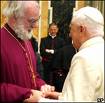
The Archbishop of Canterbury and the Pope met in Rome; they released a statement which was full of general pleasantries except for the passage below in orange.

Certain realities cannot be glossed over; the unbridgeable impasse between Rome and Canterbury is one of them. Rome finds it hard, almost impossible, to renounce its marian dogmas nor its claim to episcopal and ecclesiatical supremacy. Rome has never renounced its call for us to return to her, the Mother church. Its hard to imagine a Pope ever making an ecumenical pilgrimage to Lambeth Palace!

Anglicans are also in holy disarray. The election of a practising gay to the episcopate in the US together with the consecration of women bishops in the Anglican Church have not only sunk any hope for unity between the Anglican and Roman ecclesiastical bodies it is also forcing the the Anglican Communion to re-draw itself within catholic and apostolic boundaries. No one has his finger on what the Anglican Communion will look like after Lambeth 2008. These are the new developments which are characterised as being divisive for Anglicans in the joint statement; they present serious obstacles to our ecumenical progress. On a positive note, the divisiveness of the present Anglican drama could be the birth pangs of a biblically centred catholic and apostolic identity.

Here is the excerpt from the statement released after the meeting between the Archbishop Of Canterbury and the Holy Father:

"In this fraternal visit, we celebrate the good which has come from these four decades of dialogue. We are grateful to God for the gifts of grace which have accompanied them. At the same time, our long journey together makes it necessary to acknowledge publicly the challenge represented by new developments which, besides being divisive for Anglicans, present serious obstacles to our ecumenical progress. It is a matter of urgency, therefore, that in renewing our commitment to pursue the path towards full visible communion in the truth and love of Christ, we also commit ourselves in our continuing dialogue to address the important issues in the emerging ecclesiological and ethical factors making that journey more difficult and arduous".

The anglo-catholic parts of the Anglican communion will probably shake their heads and join the cry of the psalmist, how long oh Lord, how long. The low evangelical anglicans will shrug their shoulders and say, so what? Some might go into a state of shock to discover that Anglicans and Catholics have been talking about a visible union for many years. In Latin America, especially in many parts of the province of the Southern Cone, any talk of rapprochement with Rome, is akin to asking a Christian to converse with the unearthed remains of a dead relative convicted of paedophilia.

Until our Lord returns the only visible unity between Rome and Canterbury is our common baptism in Christ. Maranatha!

Monday, November 20, 2006


PRESTIGE: MOVIE REVIEW

"...this movie... mirrors uncontrolled male genius gone amok"

Watching PRESTIGE it is like playing chess with an imaginary board in your head; the story line weaves its way through a series of overlapping events and invites you to figure out what's actually going on in the lives of the characters. The movie not only entertains it also makes you participate in the gradual unfolding of the plot. Prestige reminds me of that great Michael Caine/Lawrence Olivier classic, Sleuth. Coincidentally Caine is also in this movie. Hugh Jackman, Wolverine/X-Men and Christian Bale, Batman sneak in and out of the their plot with some impressive performances. And Michael Caine's deceptive simplicity never fails to deliver the goods. He once told Larry King that acting is like "being in a natural conversation". Very true. Scarlet Johannson and Piper Perabo (a stage name?) don't just provide the romantic interest; they provide a foil to the motif of the movie: obsession and its underlying sub themes of illusion, deception and revenge. Nope...this movie is not about male bonding; it mirrors uncontrolled & competitive male genius gone amok. This is a good movie; its worth the money!

There is a particular masculine tendency to diabolically mock, compete and destroy. Jackman's Angier and Bales Borden are men trapped in such a pathology. They are not easy to evangelise: too clever and hardened for their own good. Only divine regenerative power can break through. And when that happens, men like Angier and Borden sing their own Psalms of healing and redemption.

Children will sleep through the movie. No nudity or foul language in the movie.

Saturday, November 18, 2006


EVANGELIZING MEN

A Talk On Communism & Socialism From A Christian Perspective At A Local Hotel Draws A Big Crowd.


What sort of a talk would interest men to consider the claims of Christ? Bolivian men like politics; the country's swing toward the left has stirred interest; the press and the radio/TV talk shows have latched on to this story. Bolivia is also no stranger to communism and socialism. So the men's ministry decided to organize a talk based on a Christian perspective of Communism and Socialism. About 2/3 of the men who attended the talk were non christians. The speaker, Leopoldo Sceti, is an experienced christian radio talk show host; he spoke for about 4o minutes. After the talk we mingled with the newcomers and invited them to a fellowship meeting in a member's home where the theme of the talk would be further dealt with. We've never done anything like this; the results are very encouraging.

There is a stereotype of men as being anti church and not interested in spiritual matters. The men's ministry is trying to undo this false stereotype. Winning men to Christ is a top priority; setting a man on fire for the Lord has an immediate and positive impact on his wife and family!

Wednesday, November 15, 2006

BOLIVIAN HERO

The guy on the right is a craftsman; he is also a prisoner; his works are on display at a special festival organized by, Palmasola, the state penitentiary in Santa Cruz. We normally associates prison with crime. This guy apparently has managed to get his creative juices flowing in prison. Jail is not an impediment for those who want to get ahead in life. Is it any surprise that he is my Bolivian hero? The language of rights does not exist in prison. Its easy to get bitter. Not this inmate. He is making the best of a "bad" situation. The Bolivian justice system is notoriously slow and inefficient. Judges can be bought. Some languish in prisons for months without having their cases tried.

The warden recently announced that they were opening a soap making factory in the prison. Most of these products are exported to the US and Japan. These initiatives provide great therapy for the prisoners and provide income for some of them. Prision should not only be a place for punishment but also a means to rehabilitate.

Tuesday, November 14, 2006

EMPOWERED CLERGY!

Last Sunday was one of the most fulfilling experiences in my life. No, I did not do anything. Others did! The Pastor who took my place in the mother church preached a powerful sermon; many responded to the altar call. He led the service with lots of anointing. At the extension centre, the deacon led a retreat for the leaders of that small work; his leadership is growing in that part of the vineyard. Its great to see, those that you've trained personally, moving into positions of great responsability. Both of them however are struggling with their theological extension courses; its not easy to study and serve at the same time. Its my responsability to not only help them finish their studies but to also mentor them in their new roles.

My dream is to raise dozens of empowered clergy filled with the Holy Spirit; some of them will be bi-vocational. This of course is a great challenge in Bolivia. Meeting needs, sometimes very basic ones, go hand in hand with a solid formation that helps one to look beyond themselves in the third world (actually thats true everywhere). People need to be fed, led and taken care of before they can go beyond their own needs and see the challenge of serving others. Configurating all this within an Episcopal church government requires a long term strategy that does not cave in to immediate demands. We are raising leaders who can lead their flock within a larger ecclesiological dynamic. Character formation, honing minstry skills and learning the bible/theology are the three basic components of our leadership training programme. The current leadership have some ways to go before they can raise leaders and project a growing a "self supporting" work. Missionaries like myself come in at this point and provide the necessary back up leadership. How to empower leaders without cultiving dependancy amongst the locals and fostering paternalism among missioaries remains the hot button issue!

Pray For Us!

Monday, November 13, 2006


INDUCTIVE BIBLE STUDY

GETTING INTO THE WORD

Last Saturday I went to a follow up workshop on inductive bible studies. The speaker was a Pastor from Cochabamba, one of the major cities in Bolivia. He bought a large number of inductive study Bibles which sold like hotcakes. These special bibles are huge with no headings or a predeterimined outline of texts which make up the books of the Bible(yes, the Bible is actually a library of 66 books and letters). With these Bibles however you get to work on the text and do your own outlines. The method rests on three pillars: observation, interpretation, application. There are of course several sub points which undergird each pillar. The essence of the method is diligent and careful reading of the text. This simple discipline helps the reader to understand the message of the book. It would be however an error to ossify the results of the inductive study method. Biblical scholarship always challenges you to think afresh about a particular book or a text. Its as if the texts are growing organisms!! This of course means that our outlines need to be revised and upgraded.

In the last decade or so we've been "blessed" or assailed by all sorts of study bibles which basically spares the reader the hard work of reading slowly, examining the flow of the text and determing the structure of a given passage or a book. All this does is to help people see the bible in terms of someone else's viewpoint and does not really encourage the reader to dig deep into the word.

The inductive bible study helps one see the literary patterns and structure of the text and it is this seeing that helps one to dig the scriptures for its jewels.

I don't know of any method or system which gets readers into scriptures like the inductive method. There are no fancy books to read or a theologian's name to refer to. It requires work but the payoff is worth it.

One of the best motivational prayers for the inductive bible study method comes from an ancient collect in the Anglican Book Of Common Prayer. Here it is:


Proper 28 The Sunday closest to November 16

Blessed Lord, who hast caused all holy Scriptures to be
written for our learning: Grant that we may in such wise
hear them, read, mark, learn, and inwardly digest them; that,
by patience and comfort of thy holy Word, we may embrace
and ever hold fast the blessed hope of everlasting life, which
thou hast given us in our Savior Jesus Christ; who liveth and
reigneth with thee and the Holy Spirit, one God, for ever and
ever. Amen.

Wednesday, November 08, 2006


TED HAGGARD’S FALL AND HIS REPLACEMENT’S SPIN


Christian witness is not morality in itself but an ongoing story of God's gift of redemption as we humbly embrace the brokenness of our sin.


Our efforts at salvaging a measure of integrity from the rubble of a scandal can sometimes sound truncated.

Rev Leith Anderson, is Ted Haggard’s replacement at the National Association Of Evanglicals (NAE). Haggard resigned because of a well publicised moral failure in Colorado. Anderson said in relation to the public perception of Haggard’s fall:

“They will understand that if there are 45,000 churches (affiliated with NAE), that 44,999 of them have leaders that did not misbehave and that one person misbehaved and that that is an anomaly." (my emphasis)

Externally, he said, people looking from the outside at evangelicals may attempt to paint them all with one brush.


“There will be those that will think the worst of evangelicals because of this and I’m sorry about that,” Anderson said. “This is not who we are. This is not what we do. This is an exception.” (my emphasis)


eerrghh…does this mean that those 44,999 churches have faultless Pastors who don't misbehave?

My sympathies are with Anderson. He's back is against the wall and something needs to be said in order to put the NAE in a good light. His statement above however borders on spin. People these days can smell spin a mile away!

He may have also unknowingly painted an overly generous picture of Pastors in his attempt to convince people that the NAE is a network of mature Pastors who do not indulge in homosexual trysts. Anderson of course is empirically right. There are men and women in difficult pastorates who are exemplary. This is not to say that exemplary Pastors don't misbehave or do dumb things. There is nothing exceptional or anomalous about sin in Christian leaders. Church history does not exactly put a positive spin on the moral failures of Christian leaders. And yeah…read the Bible too…David, Abraham, Jacob, Noah and Peter - these guys would NEVER have made it to the Times list of the top 50 influential leaders of the decade.

The difference between Haggard and the rest of us? his sins were brutally exposed; ours are either hidden, tolerated or seen as Christian virtue. Most Pastors may not be involved in homosexual trysts. Several of us however lie on occasion, exaggerate in the pulpit, struggle with pornographic temptations, get angry, cuss and yell, don’t pay taxes; there are times when we say “God told us” …when in fact He did not. And let’s not forget all the prideful religious back biting. Pastors don't model political correctness but the terrifying and bloody work of Christ's redemption in our lives.

"whoever keeps the whole law and yet stumbles at just one point is guilty of breaking all of it. Jas 2:10"

When people taunt us for our moral failings, lets repent and NOT take refuge in our own sense of righteousness and claim it was an exception or an anomaly. Suffering taunt and lampooning for our sins is good for the soul! The Psalmists and the writer of Lamentations saw God's hand behind the sorrow of their sins and it was to Him that they directed their cry.

The self deception and self denial that drove Haggard’s "misbehaviour" lurks in all Pastors and takes different sinful shapes and forms. And that, Leith, is neither an exception nor an anomaly!

Pray for your Pastor and his family.

Monday, November 06, 2006

SOMETHING TO CHEER ABOUT!

The Bolivian Government Sucessfully Renegotiates Contracts With Oil Companies

President Evo Morales and his cabinet, through some pretty deft negotiations, have signed new contracts with major oil companies. With these new contracts Bolivia not only gets a higher percentage of income earned from the sale of petroleum products but also have a greater say in the production of their natural resources. We are seeing, perhaps for the first time in Bolivian history, a concerted and joint effort by petroleum companies and the government to work out a deal that will benefit both parties. In the past the country swayed from the extremities of nationalisation and privatization. Lets pray and hope that the increase in the national income will trigger more growth and social justice.

Lets give credit where its due. The Bolivian goverment served the long term interests of its people in these difficult negotiations. There was talk of nationalising the oil industry and the previous minister who led the negotiations resigned because expropriating foreign property was a non starter from the word "go". The new minister and his team however managed to put together a deal which the oil companies could accept.

Bolivia's problems will not vanish overnight but there seems to be some positive traction; the government appears to be bringing people together and some of the divisive rhetoric has diminished somewhat.

Thank You For Your Prayers.

HANDS FULL ON SUNDAY!


A Youth Pastor Had The Opportunity But Did Not Share the Gospel With Che Guevara!


3 Ten Year Olds Sit Through A 40 Minute Adult Bible Teaching Without Fidgetting!

I had my hands full last Sunday. The Senior Clergy was on leave and I covered his duties which included lots of teaching, preaching, counselling and administrative stuff. The lay leaders were out in full force and did their part in ushering, preparing breakfast and helping distribute the wine and the wafers. We had a few newcomers. One of our members was weepy because she could not witness her son's marriage in the States; the US embassy had rejected her application for a visa (a very common outcome due to the illegal imigration)

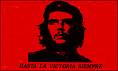
As usual its the priestly task of preaching, teaching and celebrating the eucharist that gets my juices flowing. These days I try to not only evangelise through my messages but to also get christians to witness for Christ to non christians. Getting people fired up to do evangelism can be challenging, frustrating and rewarding. I closed my sermon with a story of a youth pastor who, although presented with many opportunities, did not share Christ with Che Guevara when Che was a youngster; the story is documented in a book written by Junior Zapata. Che Guevara has a hypnotic hold over the left and the dreamers in Bolivia (as well as in Latin America) partly because he was killed in the jungles of Bolivia. He is now part of the pantheon of heroes in Latin American. Zapata rhetorically asks, "What would have happened, to Latin America, if Guevara had become a Christian". The Lord brings people into our paths so that we can share Jesus with them.

At the nigth Service I taught on the Christian perspective of "Life After Death". I saw 3 ten year olds enter the sanctuary with their dad. He came to the night service because he could not come for the morning Eucharist. My heart sank because my teaching was going to be long and directed to adults. It was an interesting experience because the 10 year olds sat through the 40 minute exposition of the intermediate state, heavenly rewards, judgement, and the final restoration of creation without making a fuss or throwing a tantrum. Unbelievable. There were moments when they looked as if they were listening to the teaching! We have no Sunday School during the night services. One of the them actually responded to my prompting to read some of the Scripture passages aloud during the sermon.

After the service I went to buy a take-out for the family; I returned home, tired, and thankful for the day's experiences.


Tuesday, October 31, 2006


YOURS TRULY IS MADE ARCHDEACON


It was a hot and humid Sunday morning in Santa Cruz Bolivia. People were using their bulletins as a fan. We were celebrating the witness of the Saints departed last Sunday. ALL SAINTS occupies a special place in my heart. I pastored a church called ALL SAINTS in Singapore before my departure for Bolivia nearly 14 years ago.

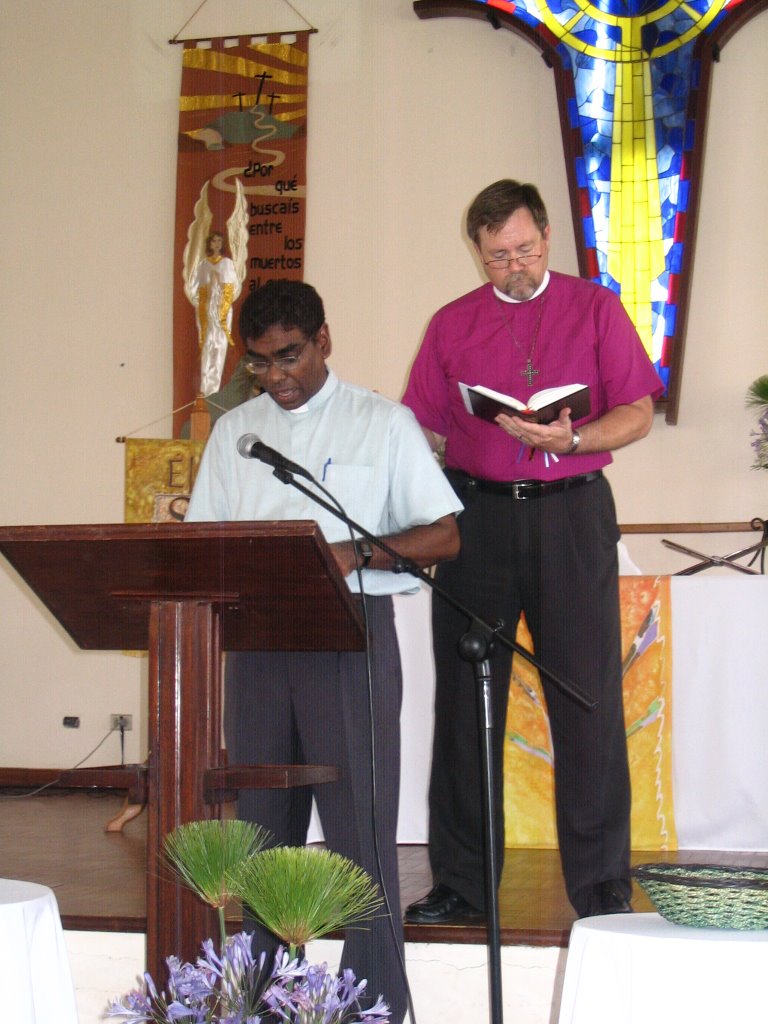
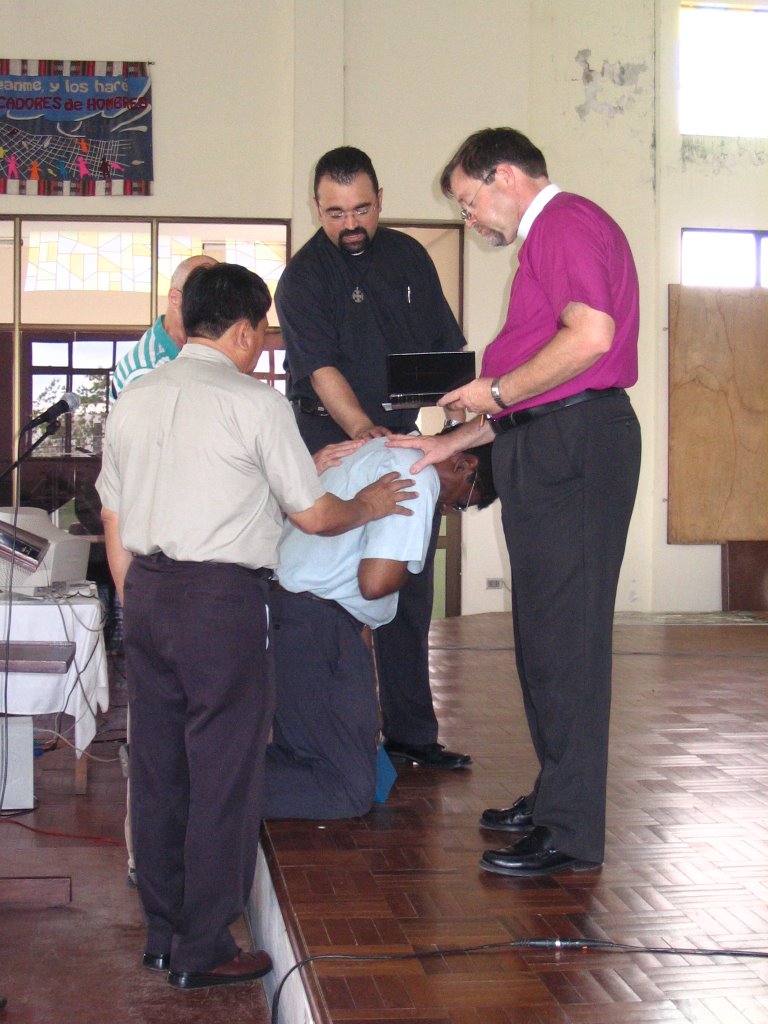
I was ALSO ordained as a deacon (1995) and priested (1996) on the Sundays before ALL SAINTS DAY in the diocese of Singapore. By a strange coincidence (I stand corrected - there are no coincidences in the Kingdom!) I was recieved as Archdeacon on the Sunday before ALL SAINTS DAY of eastern Bolivia in the parish Christ Light Of The World, by the Bishop of Bolivia, Frank Lyons. Some of the diocesan clergy who had attended the standing committee meeting the day before, stayed behind for the Sunday service and prayed for me. I appreciated that show of support.

If someone had told me 20 years ago that I would be an Archdeacon in a South American diocese I would have written him off as crazy!!

VIOLENCE AGAINST CHRISTIANS IN IRAQ!

RAPES, MURDERS, KIDNAPPINGS!

BOLIVIAN BEAT ASKS, "WHERE IS THE OUTRAGE FROM PROMINENT CHRISTIAN LEADERS CONCERNING THE PERSECUTION OF CHRISTIANS IN IRAQ!!

From the Barnabas Fund http://www.barnabasfund.org/

Thousands of frightened Iraqi Christians are fleeing Iraq, after an escalation in anti-Christian violence. Several horrific attacks on Christians in the last three weeks have increased the fear amongst the Christian community. This appears to be a response to a call by militants for increased violence during the Islamic fasting month, Ramadan (which this year is 24th September - 23rd October).

On Wednesday October 4th an explosion was detonated in the mainly Christian district of Camp Sara, Baghdad. As people gathered round to help the wounded a second, larger explosion occurred. Nine Christians were killed in the attack, one of the largest deathtolls for a single attack. Observers say that the timing of the two consecutive bombs was similar to that of the attack on a church in Baghdad on 24th September.

On Tuesday 10th October Paulos Iskander, an Iraqi church minister, was abducted in Mosul. Iskander's eldest son received a phone call from the kidnappers demanding a ransom of $250,000; the family, unable to raise this money, were able to negotiate for a ransom of $40,000, but the kidnappers also demanded that Iskander's church publicly repudiate the remarks about Islam quoted by Pope Benedict XVI last month. When Iskander's family asked for proof that he was still alive the kidnappers held up the phone so that the sounds of crying and screaming could be heard. The family began to raise the ransom by asking churches and Christians in the area to help, and arranging several loans. Iskander's church as well as several other churches placed 30 large posters around the city to distance themselves from the Pope's words. However, before the ransom could be paid Iskander's decapitated body was discovered on 12th October, dumped in an outlying suburb of Mosul. His body showed signs of torture, with cigarette burns, bullet holes and wounds from beatings. His hands and legs had been severed, and arranged around his head which was placed on his chest. Iskander's family later received a phone call from the kidnappers, who taunted them that Iskander "had a lot of blood in him".

In Baquba, 65km north-east of Baghdad, a Christian doctor was abducted and killed on his way to work in Baquba hospital. There has also been an unconfirmed report that a 14-year-old Christian boy was crucified in Basra. Amidst the surge in hostility towards Christians in recent weeks, Christian girls have increasingly become the target in a spate of kidnappings and rapes. The girls are taken from their families at gunpoint, from their homes or snatched off streets into waiting cars. They are frequently raped and abused while in captivity, only released if their families are able to find the large ransoms demanded.

The shame of their ordeal, which is felt far more in such a culture than in the West, can make the victims suicidal. In one case a girl killed herself after being abducted and gang raped by nine men. When the abductors allowed her to call her family she asked them not to pay the ransom. The family did pay and she was returned to them, but she was found dead the following morning; she had taken an overdose of sleeping pills. In another case five Christian girls were kidnapped in front of policemen as they tried to obtain passports from a travel and citizenship department in Baghdad. The police did nothing to try to stop the kidnappers. Indeed police forces in Iraq generally seem either unable or unwilling to do anything to protect Christians, and it is reported that some are even participating in these brutal crimes against Christian women and children.

As Christians leave their homes out of fear of the violence around them, some have been specifically threatened to force them to leave. Thirty families in Mosul received messages on their mobile phones on 30th September telling them to leave within 72 hours or they would be killed. The continued exodus of Christians from Iraq and persecution of those who remain leads some to predict that there may soon be an end to the ancient Christian presence in this country.

*Please pray for shocked and grieving Christians coming to terms with the horrific deaths of their loved ones. Pray that they will have peace in their hearts, and feel themselves comforted and protected, held in God's everlasting arms. * Pray for peace in Iraq, and in particular that the violence against Christians will come to an end. Pray that police and security forces in Iraq will protect all citizens irrespective of their faith.

Friday, October 27, 2006

THE (Bp)FRANK LYONS INTERVIEW

The Bolivian Beat recently interviewed Frank Lyons, Anglican Bishop of Bolivia. Bishop Frank and his wife Shawnee served in Ecuador and Honduras before the Lord called them to serve in Bolivia. They have 5 grown up children. One of them is in Baghdad Iraq and the others are studying and working.

BB: How did you come to a personal knowledge of Christ as your Saviour and Lord?
Bp Lyons
: I came to the Lord as a young lad of six when I was confronted with long periods of debilitating earaches (they would operate to allow for drainage). I turned to the Lord for healing. A few years later, watching the movie “King of Kings” one Holy Week, I realized that Jesus bore his cross personally for me. I was also nourished by a good Sunday school at Loch Raven Presbyterian in Towson, MD. Other experiences as a youth deepened that faith.

BB: You knew Abp Michael Ramsay the former Archbishop of Canterbury when you were a student at Nashotah House. What were your impressions of him?
Bp Lyons: Abp Michael Ramsey is an imposing figure for Anglicanism with his combination of Bible and liturgy. He was foremost a Biblical theologian. He is criticized for this because the tendency is to place systematics above biblical theology. That affected him as well, especially in the (old) Robinson “God is Dead” affair. I believe that by his actions he saved John Robinson’s soul, whereas, James Pike was allowed to wander and perish in the desert. However, as I now read the various biographies, Ramsey regretted his actions until his death as somehow a denial of the unwritten Anglican charity of “openness to whatever doctrine” that in effect pits ego-intellectualism against true faith. Personally, we had some brief chats, but I was not one of the students who maintained a deep, ongoing relationship. He did follow our missionary career with interest.

BB: Who were some of the people that influenced you in your growth as a person and as a pastor/Bishop?
Bp Lyons
: My participation at the two local churches of my youth was rewarding, especially with David Lord’s biblical teaching. Mentoring has not always been an Anglican focus, so my studies and reflection on the ministry have aided me. The Bible faculty at Wheaton, especially Al Hoerth, Hassel Bullock and Gerry Hawthorne, and later Peter Wagner at Fuller, have been of greatest value to me. The time in ministry spent with Steven Giovangelo and the congregation of St. Luke’s of the Mountains in La Crescenta, CA, was invaluable to my and Shawnee’s ministries.

BB: Can you share with readers your experiences In Renewal?
Bp Lyons
: My teenage years were spent at St James Church in Potomac, MD, which was dynamically charismatic. Our rector, David Lord, was a solid Bible teacher and our youth group was very active spiritually. Many people matured in a balanced faith and five others were also called into the ministry during that era. Renewal presented a problem for our Diocese which opposed our version of the “faith once delivered” at every step. Openness to the Spirit does not necessarily mean excess when tempered by clear biblical training, but rather compliments it.

BB: The biggest challenge you face or faced and the most satisfying moment in life ?
Bp Lyons:
My biggest challenge came when the Lord called us overseas to minister cross culturally. I think I was planning to go to some nice quiet, maintenance oriented suburban church. I do not have the adventuring/discovery gifts that I consider necessary to be a missionary. Flexibility and an orientation to lifelong learning help me make up for those deficiencies. The great need for development is what keeps me on track here; developing people mentally, materially, and spiritually as disciples of Jesus.

BB: You participated in a dig in the Holy Land as an archeologist. How has archeology deepened your faith?
Bp Lyons: I dug at Beersheva in the sixth season under Y. Aharoni and A. Rainey, where a horned altar had been discovered previously. Kathleen Kenyon visited that summer. A lot of brute strength was involved in trying to dismantle the Herodian foundations superimposed there. Archaeology is critical in illuminating the text of Scripture and bringing home Jewish culture. As the gentile Church grew out and away from the Land we lost sight of the role of geography and Jewish culture in this context. When Jesus says something, “where he is” and “his culture” are as important as the way in which he says it.

BB: What’s your favorite Bolivian food and why?
Bp Lyons My favorite is Pique Macho. Mouth watering pieces of filet mignon are cooked in a meat sauce with franks or sausage and are placed with fresh tomato, onion and locoto over a bed of piping hot French fries. Locoto is the local pepper which varies in strength within each piece. Delicious, but much like Russian roulette.

Monday, October 23, 2006


BUSTED FRIENDSHIPS!


FIXING THE HUMPTY DUMPTY OF ESTRANGEMENT

How easy it is to lose a friendship: Raw feelings are exchanged after a silly misunderstanding (sometimes through emails)...the atmosphere turns tense...harsh words are then exchanged...attempts to clarify the situation only makes matters worst and before you know it, a friendship is lost. Its kinda painful. You ask yourself - how did this happen?

Its been years...you would like to restore the relationship...but you've lost contact with the person. There does not seem to a practical reason to get back together but something in you wants to be reconciled with the friend you lost. You make contact with the person...hullos are exchanged...we shake hands as an act of courtesy...the smiles are forced. A shallow conversation begins to move the tectonic plates but nothing really happens...the magic isn't there anymore. Lost friendships, like humpty dumpty, are hard to put back again. And the virtue of making the first move to be reconciled, some times, does not elicit a positive response.

Our failures provide a stark contrast to the way in which God fixed our estrangement with Him. This is one Friendship which was restored to the fullest. He made the first move: He came as a human being - the Christ who responded to His Father's initiatives on our behalf because we were busy stroking our own egos; He stretched Himself on the cross, forgave and regenerated us in order to bring about reconciliation. He reached out...drew us toward himself and we felt his Holy embrace! The biblical narratives of reconciliation between Joseph and his brothers, Isaac and Esau not only mirror Christ's cosmic reconciliation but also serve to inspire us to work at wounded relationships. Now that's a happy ending.

Tuesday, October 17, 2006

¡BOLIVIAN EXODUS!

MASSIVE EMIGRATION TO SPAIN

Juan and his fiancée, María are a neat couple; they indicated their willingness, a few months ago, to become members of our church. We were thrilled; they flowed with us easily, understood our philosophy of ministry and were potential leaders in the youth ministry. A week ago they told us that they were marrying soon and leaving for Spain in November. Juan got a promising job offer with a remuneration that no employer in Bolivia could possibly match; Bolivians provide cheap labour in highly competitive European capitalist economies.

There are literally thousands of “Juans” and “Marias” who’ve left Bolivia for Spain. The pace of emigration has surged dramatically because of Spain’s impending decision to demand visas from visitors and guest workers from Latin America. The other reasons are the lack of good job opportunities and the current instability in Bolivia. Lengthy queues of people carrying files with travel documents are a common sight at the government immigration office and travel agencies.

There appear to be some “pluses” in this mass exodus. Immigrants and guest workers send remittances to their loved ones in Bolivia. Some single young men and women with no family responsibilities have been blessed by a new environment and the availability of jobs and opportunities. Hard cash from abroad not only helps needy Bolivian families but also serves to inject movement in a financially strapped economy. This could explain the reticence on the part of the Bolivian government to put into place policies that discourage emmigration. Another “plus” is the growth of the Spanish Church. A mission director said recently that Latin American emigration has helped to fill Christian Churches in Spain.

Here’s the bad news. Emigration has contributed to the disintegration of the Bolivian family. Husbands and fathers, after spending many years in Spain, have been known to abandon their wives and children in Bolivia for other women. Teenagers and children are left with relatives while their parents leave for greener pastures. Some emigrants make provision for their families to join them after years of hard labour while others simply abandon them. Spain these days is'nt exactly a model of moral rectitude. Franco’s conservative Spain died in the 70’s. Modern Spain is very permissive; they champion gay marriage in Europe. It’s not hard to see well intentioned Bolivians falling to temptation in such an environment.

And so is this Bolivian exodus a good thing? The massive brain drain will ultimately worsen Bolivia's economic plight; the absence of a parental figure in the home will breed a generation of dysfunctional children. The Lord in bringing good out of evil never justifies the evil. Yes, the Christian Church in Spain appears to have benefited from this migration but this is not a license to put a positive spin on the breakdown of the Bolivian family nor does it absolve the Bolivian government from its responsability of removing barriers to job creation. Some have improved their well-being after having migrated to Spain. In terms of long term national development, however, this exodus is NOT a healthy development.

Pray For Bolivia.

JOHN STOTT ON TOLERANCE, PROSELYTISM & EVANGELISM

In an interview with Christianity Today (Jan 2003 Greg Barnes) John Stott clearly defined tolerance and proselytism as it relates to the evangelistic/missionary impulse of the church.

CT: Our Critics Accuse Us Of Intolerance And Proselytism.

STOTT: Much of our debate is conducted in what might be called "conditions of low visibility," because we do not always pause to define our terms. This is evidently so in relation to these two words.

Tolerance is one of today's most coveted virtues. But there are at least three different kinds of tolerance.
First, there is legal tolerance: fighting for the equal rights before the law of all ethnic and religious minorities. Christians should be in the forefront of this campaign. Second, there is social tolerance, going out of our way to make friends with adherents of other faiths, since they are God's creation who bear his image. Third, there is intellectual tolerance. This is to cultivate a mind so broad and open as to accommodate all views and reject none. This is to forget G. K. Chesterton's bon mot that "the purpose of opening the mind, as of opening the mouth, is to shut it again on something solid." To open the mind so wide as to keep nothing in it or out of it is not a virtue; it is the vice of the feebleminded.

The other word we need to define is proselytism. To proselytize and to evangelize are not synonymous. The best way to distinguish them is to understand proselytism as "unworthy witness." The World Council of Churches and the Roman Catholic Church produced a helpful study document in 1970 titled Common Witness and Proselytism. It identified three aspects of proselytism. Proselytism takes place (1) whenever our motives are unworthy (when our concern is for our glory rather than God's), (2) whenever our methods are unworthy (when we resort to any kind of "physical coercion, moral constraint, or psychological pressure"), and (3) whenever our message is unworthy (whenever we deliberately misrepresent other people's beliefs).

In contrast, to evangelize is (in the words of the Manila Manifesto) "to make an open and honest statement of the gospel, which leaves the hearers entirely free to make up their own minds about it. We wish to be sensitive to those of other faiths, and we reject any approach that seeks to force conversion on them."

Friday, October 13, 2006

ARE CHRISTIANS AND MUSLIMS PRAYING TO THE SAME GOD?

Mutual Respect Requires Us To Reply In The Negative. 

Vast segments of Islam and Christianity will say - “NO”. Muslims and Christians adhere to 2 diametrically opposed revelations: Islam speaks of a god who is One and his name is Allah; Christianity proclaims a Triune God - Father, Son, And Holy Ghost. Trying to reconcile these revelations with the notion that Muslims and Christians have not understood the fullness of the true god is condescending and betrays an ignorance of revelation based religions. The axiom that all religions worship the same God is a popular expression from well-intentioned people - this universal fuzz however displays ignorance of  Islamic and Christian beliefs. 

A Muslim would never agree to the assertion that Allah and the Triune Christian God are one and the same. Christians would heartily agree!! Does this mean that Islam and Christianity are destined to collide? Again the answer is “NO”. The Biblical accounts abound with examples of peaceful co-existence between God’s people and those from different religions and cultures. Joseph played a critical role in pagan Egypt; he found ways to work with Pharoah, a self-proclaimed god-king. Moses took advice from Jethro, Midianite. Nehemiah was an administrator in the Persian court which was sympathetic to a universal vision of religious beliefs. And Jesus did not offend the gods of the Roman Empire; He also resisted all forms of national religiosity as embodied in the Zealots.

What of the texts which appear to encourage conflict between worshippers of other gods and God’s people? The Old Testament prophets in their attempt at protecting the transformational calling of God’s people railed against syncretism and idolatrous worship. There is however no evidence of God’s people taking arms against other nations of different religious beliefs on the basis of religious calling. As a counter-argument, however, the destruction of the Canaanite peoples by the Israelites and the conflicts between the Philistines and Israel appear to foster inter-religious warfare. A closer reading however of these episodes within the larger narrative of God’s judgment of His own people, Israel, helps us conclude that God’s sovereign judgment does not favor any religion or nation. 

He uses the nations of the earth as his temporary instruments to judge other nations. For instance, Israel was his instrument of judgment against the Canaanites; He used Babylon later to judge Israel. The favour Christians enjoy as God’s people is derived from the favor that God the Father showed his Son, Jesus. As Christians, we are called to be peacemakers. This is not easy, especially in countries where other religions dominate. The Biblical testimony of Daniel is an important model for Christians who struggle as a minority. Christian leaders are called to peacefully co-exist with people are hostile in their attitudes toward God’s people.

Lord, grant us the patience to bear with injustices and the courage and humility to stake our claims and rights. Hence the constant need for dialogue and mutual understanding so that we may all live peaceful and quiet lives in all godliness and holiness (1 Timothy 2: 1-2).

Wednesday, October 11, 2006


A SOBERING EXPERIENCE!!

Sunday Service: Reacting To The Tragedy At Huanani

Last Sunday's service was a sobering experience; the tragic events at the mining camp which left 16 dead and nearly a hundred seriously injured were in the minds of many as we gathered for Sunday worship. People had been expecting a dangerous confrontation given the rising tensions within the country. No one however expected a flare-up between the miners - allies of the present government. There is a sense that this will only be the beginning of other acts of violence.

We stood in the breach and asked for forgiveness for the sins of violence and hatred; prayers were offered for the families of the loved ones. I preached on the beatitude, Blessed Are The Peacemakers For They Shall Be Called The Sons Of God". My heart ached for the Bolivian people as I preached; the eucharist drew us into His sacred presence and gave us the strength to face the future as peacemakers. Amongst some of of the stories of encouragement I used in the message were Archbishop's Robert Runcie's decision to have a service of reconciliation and peace after the Falklands War (much to the consternation of some British politicians who wanted a service of victory!) and the Commission of Justice And Reconciliation in South Africa which forgave those who confessed to violent crimes during rule of Apartheid. Sharing the peace during the service and sending God's people into the world with the assurance of His presence was especially meaningful.

Pray for us!

Friday, October 06, 2006


TRAGEDY!

16 Dead...61 Injured


A conflict over mining rights between 2 groups of miners, yesterday, turned violent at a place called Huanani in the state of Oruro (Bolivian Highlands). One group began to hurl dynamite! A hospital was destroyed. The place looked like a war zone! 61 miners were injured and 16 lost their lives. One of the groups enjoyed the support of the government during the last general elections. A grim looking, Evo Morales, president of the nation, went on national TV to announce the resignation of the cabinet minister who was overseeing the dispute which apparently surfaced in July this year; a replacement was appointed immediately. The miners are a feared constituency in Bolivia; normally their participation in any protest spells trouble for the party in power. The next few days will hopefully bring some sense of order and calm.

The business community in Santa Cruz is putting together a number of initiatives to help the mining community where the incident took place. They've collected dry rations, raised funds and have encouraged people to donate blood. These are good moves because they help ease tensions and build solidarity between Santa Cruz and the peoples from the highlands. Bolivia is deeply divided as the constitutional assembly struggles to craft a new constitution that will hopefully promote social justice and unite all sectors of society. The deaths of these miners has shaken everyone and maybe this tragedy will bring the nation together!

This Sunday, God willing, I hope to draw on the Biblical teaching of Christian peacemaking in society as we manifest our calling to be salt and light of the earth.

Thursday, October 05, 2006

SO WAS HENRY 8th FOUNDER OF THE ANGLICAN CHURCH?

Uuuhhhh....NO!

Henry 8th was a poster boy for intrigue and scandal in the 16th century tabloids. His court briefings would have made front page news and hogged the 24 hour news cycle! And so its odd to hear people saying that this fellow was founder of the Anglican Church or that the Anglican Church was the result of a divorce.

“Wasn’t Henry 8th founder of the Anglican Church? Bolivian history textbooks under Roman influence resoundingly reply – Yes! The irony is that some low evangelicals would probably agree to this soap opera view of church history. Some might not even bother with the issue. This post does not arise out of any desire to defend the Anglican Church but rather reflects my interest in European Church history. So if you like to know something about Anglican origins…read on…

The gospel according to some historians was brought to the British Isles by an unknown cast of merchants, soldiers, tradesmen. The Anglican Church traces its beginnings to the 3rd century in Britain; Bishops from the British Isles were present at the council of Arles; an indigenous sort British Christianity (call it Celtic if you wish) existed prior to the coming of the first Roman missionaries in the 6th century.

Pope Gregory sent Augustine in the 6th century to the British Isles as a missionary to help in the evangelisation of Britain. Like it or not, the Roman church was a later accretion within British Christianity. The Roman and British faith traditions went through a period of interpenetration with Rome being the dominant partner. This interpenetration however did not dissolve Rome and Britain into one religious and political entity. Regional, cultural and religious differences in Europe coupled with medieval political intrigue provided the setting for a topsy - turvy relationship between Rome and the British ruling elite throughout the centuries. Everything came to a head in the 16 the century when Pope Clement did not allow Henry to divorce his wife and remarry; Henry was desperate for a male successor to the throne. The swirling forces of the Reformation and regional nationalistic loyalties gave Henry the necessary groundswell to cut links with Rome and assert a popular sort of Protestant Christianity in Britain. Rome however had its supporters in the royal court as well as in the streets. Henry’s actions triggered conflicts in the country and Britain was characterised by convulsions during the reigns of Henry’s successors - Edward and Mary. Queen Elizabeth, during her 40 year reign, stabilized the country, and provided the structures necessary to keep the Church of England intact. The rest is history…

So was the Anglican Church the result of a divorce? No it was not and here’s why.

Henry 8th’s divorce did not herald the beginning of the Anglican Church but was rather one of the many events in the 16th century which indirectly set the stage for the renewal of the British church. The tectonic religous plates were already shifting before the divorce: educated laity were reading the Bible, Luther's ideas were taking root; slowly but surely superstitions were being questioned. History suggests that the Anglican church was not a renegade Roman Church that Henry managed to make Protestant through his divorce. Henry, the astute politician that he was, rode the Reformation tiger, assumed ecclesiastical powers and freed himself from Roman dominance.

So who was responsible for the origins of the Anglican Church? It’s great public relations to have a Luther, Calvin, St. Francis or a Cho Yong Gi as founder of your movement or Church. Anglicans however will have to settle for a cast of unknown evangelists. The Anglican Church, not unlike the New Testament gentile churches in Rome and Antioch, traces its beginnings in the 3rd century through the labours of dynamic lay people – soldiers, businessmen and merchants. And wait a minute - isn’t that Christ's Church in action!!